
Blog
The Art of Jewelry Design: From Creative Inspiration to a Finished Piece
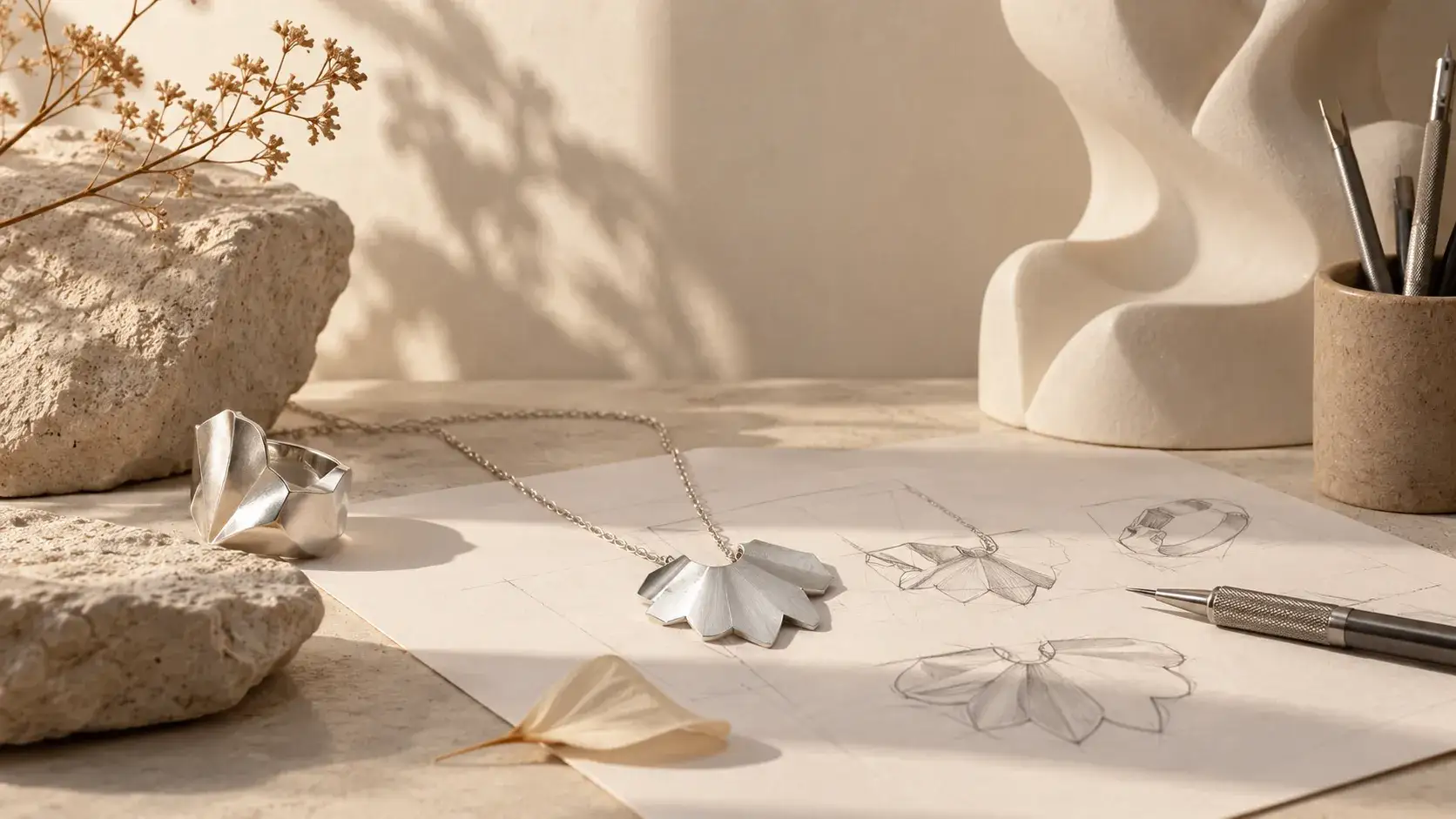
The Art of Jewelry Design is the process of transforming an idea, inspiration, or personal story into a wearable object through creativity, technical knowledge, and careful material selection. From the first sketch to the final polish, every decision influences the appearance, comfort, durability, and character of a piece. At Mahshid Gallery, contemporary gold and silver jewelry draws inspiration from nature, movement, sculptural forms, and simplicity.
Jewelry design involves much more than choosing gemstones or creating an attractive shape. It requires an understanding of proportion, balance, materials, construction, and the relationship between a piece and the person wearing it. Whether designing a delicate ring, a sculptural necklace, or a pair of expressive earrings, learning the principles behind the process helps turn creative ideas into thoughtful, well-crafted jewelry.
The Art of Jewelry Design
Jewelry design combines artistic expression with practical problem-solving. A designer develops the visual concept of a piece while considering how it will be made, how its materials will behave, and how it will feel when worn. The design must balance appearance with function, especially when working with precious metals, gemstones, and intricate structures.
The process can begin with a natural shape, an architectural detail, a personal memory, or an exploration of texture. Designers then translate these observations into sketches, proportions, and material choices. The result may be a one-of-a-kind piece, a coordinated collection, or a design intended for repeated production.
The Art of Jewelry Design is therefore both creative and technical. A strong concept needs a clear visual identity, but it must also be practical enough to develop into a finished object.
The Fundamental Principles of Jewelry Design
Understanding basic design principles helps create pieces that feel intentional rather than random. These principles guide decisions about shape, scale, detail, and the overall relationship between different elements.
Balance and Proportion
Balance refers to how visual weight is distributed across a piece. A symmetrical design may use matching shapes on either side of a central point, while an asymmetrical design can create interest through contrasting forms that still feel visually connected.
Proportion concerns the size relationship between components. For example, the dimensions of a gemstone should work with the setting, band, or pendant structure around it. A well-proportioned design feels cohesive and considers the scale of the finished piece in relation to the wearer.
Line, Shape, and Form
Lines guide the eye and can make a design appear delicate, geometric, fluid, or bold. Curved lines may suggest movement, while straight lines often create a more architectural impression. Shapes establish the basic outline, and form introduces three-dimensional volume.
Designers should consider how a piece looks from different angles, not only from the front. This is particularly important for sculptural jewelry, where depth, silhouette, and negative space contribute to the overall appearance.
Texture and Contrast
Texture adds visual and tactile character. Polished metal reflects light, while brushed, hammered, or matte surfaces create different effects. Contrast can also come from combining smooth and rough surfaces, warm and cool tones, or substantial forms with delicate details.
The most effective contrasts support the design concept. Adding too many unrelated finishes or decorative features can make a piece feel visually crowded.
Unity and Repetition
Unity connects the different parts of a design, helping them feel as though they belong together. Repeating a curve, motif, texture, or geometric shape across a collection can create a recognizable visual language.
Repetition does not require every piece to look identical. Instead, a consistent design element can connect rings, necklaces, earrings, and bracelets while allowing each item to maintain its own character.
Finding Inspiration for Jewelry Designs
Inspiration can come from almost anywhere, but successful design involves observing details and translating them into a form that can be worn. Nature is a frequent source of ideas, from the branching structure of plants to the irregular surfaces of stones and the movement of water.
Architecture offers another rich source of inspiration through rhythm, proportion, structural lines, and geometric shapes. Everyday objects, cultural references, memories, and human movement can also influence a design.
To develop an initial idea, designers can:
- Collect photographs, sketches, and material samples in an inspiration board.
- Observe the shapes, textures, and patterns that make an object distinctive.
- Explore several variations instead of settling on the first concept.
- Consider how the design relates to the intended wearer and occasion.
- Identify one or two central ideas that should remain visible in the final piece.
Choosing Materials for Jewelry Design
Material selection affects a piece’s appearance, weight, construction, durability, and care requirements. Gold and silver are widely used in jewelry, but each material has different properties and finishing possibilities.
Gold and Silver
Gold is available in different alloys and colours, depending on its composition. Its suitability depends on factors such as the design, intended use, budget, and required finish.
Silver, including sterling silver, offers a versatile surface for both minimal and sculptural designs. It can be polished for a reflective finish or treated to create a softer visual effect. Designers should consider tarnishing, cleaning requirements, and the way the metal will interact with other components.
Gemstones and Decorative Elements
Gemstones introduce colour, texture, and focal points. Their hardness, shape, dimensions, and setting requirements affect how they can be incorporated into a design. Some stones are more sensitive to impact or heat than others, making material knowledge important during production and maintenance.
Not every design needs a gemstone. A piece can create visual interest through metalwork, proportion, surface treatment, or an unusual silhouette. The material should support the concept rather than simply add decoration.
The Role of Technology in Modern Jewelry Design
Digital tools have expanded the ways designers can develop and communicate their ideas. Computer-aided design (CAD) software allows a piece to be modeled in three dimensions, making it easier to inspect proportions, visualize details, and prepare certain designs for production.
Three-dimensional printing may also be used to create prototypes or patterns for specific manufacturing methods. However, digital tools do not replace the need for design judgment, material knowledge, and careful finishing. A model that looks convincing on a screen still needs to work as a physical object.
Traditional sketching and handcraft remain valuable because they encourage direct experimentation with form, texture, and scale. Many designers combine digital techniques with manual processes to benefit from both precision and hands-on refinement.
Common Challenges in Jewelry Design
Designers often face challenges when trying to balance visual ambition with practical requirements. A complex shape may look striking but prove difficult to manufacture, while a large decorative element may affect comfort or balance.
Common challenges include:
- Poor proportions: Components may look disconnected or overwhelm the overall design.
- Material limitations: A chosen metal or gemstone may not suit the intended structure or production process.
- Insufficient comfort: Sharp edges, excessive weight, or awkward dimensions can make jewelry difficult to wear.
- Overcomplicated details: Too many competing features can weaken the central concept.
- Unclear construction: Designs need workable connections, settings, and structural support.
Conclusion
The Art of Jewelry Design brings together creativity, material knowledge, technical planning, and craftsmanship. From finding inspiration and developing proportions to selecting metals, refining details, and finishing the final piece, each stage contributes to the design’s character and wearability.
The strongest designs balance a clear visual idea with thoughtful construction. By practicing the fundamentals, exploring materials, and refining concepts through sketches and prototypes, designers can create jewelry that expresses a distinct point of view while remaining functional and carefully made.
FAQ
- What are the most important principles of jewelry design?
Balance, proportion, line, shape, texture, contrast, and unity are among the key principles. They help designers organize visual elements and create pieces that feel cohesive and intentional.
- Do you need drawing skills to design jewelry?
Drawing skills are useful for communicating ideas and exploring proportions, but designers can also develop concepts through physical models, digital tools, and material experiments. Technical drawing skills can be improved through practice.
- Is digital modeling necessary for jewelry design?
No. Digital modeling is useful for certain designs and production methods, but it is not essential for every project. Hand sketches, prototypes, and traditional techniques remain effective depending on the intended piece.
- How do materials influence a jewelry design?
Materials affect colour, weight, texture, durability, construction, and maintenance. Designers should choose metals and gemstones based on the concept as well as the practical requirements of the finished piece.